Sleep Webinar Part 4: What can be done to improve sleep for children with Down’s Syndrome? - Professor Cathy Hill
There are various approaches that can improve sleep practices for children with Down syndrome. Professor Cathy Hill explains some of the most important aspects to consider and opportunities to create improvement.
You can watch this section of the Webinar here on YouTube.
Interventions and Psycho-education
There are some beautiful research projects out there that are looking at ways of managing insomnia in children with neurodevelopmental differences. Most of the work so far has been in children with autism spectrum disorder and children with ADHD, and there have been much smaller projects in children with Down syndrome, but there are some projects out there that have looked at approaches, what we call psycho-education approaches, so working with parents to promote good sleep habits and teach people different tricks of the trade if you like to try and manage some of these really tricky situations at bedtime and they do work.
Evidence for interventions: There have been different ways of doing it – some people do it with a therapist, some people do it with an online website or a digital intervention – and there's been enough work in children with autism that somebody's been able to lump all the research together in something called a meta-analysis, that's just a fancy scientific way of putting all the data together and seeing if there's a truth in amongst the data. Those sort of analyses show that these interventions genuinely do work in children with autism and I certainly from my clinical experience there are a lot of gains that can be made from these approaches as well in children with Down syndrome.
Practical Sleep Hygiene and Habits
I want to skip through some facts about what we call sleep hygiene or what we like to call more commonly now, good sleep habits. So what are the simple things that we can do that help all of us sleep?
The importance of routine: Bedtime routines, it sounds kind of boring, doesn't it? Sounds pretty obvious, but it is the bedrock. It is so, so, so important. Children really benefit from that stepwise sequence of events leading up to bedtime. And the more rigid and the more same it is, the better for the child.
Visual tools and preparation: I've got some pictures there of visual timetables. These things are great for children: countdown timers so that they know they've got 10 minutes before bed or whatever. It's based on classic psychological theory. You learn to associate a sequence of activities with what's going to happen next. I think we have to remember none of us make a sudden transition very easily, do we? We like a little bit of preparation. We like to know what's coming next. We like to prepare ourselves for change. Children are very much the same.
Making bedtime positive: If you can make that positive time as well – and I think most people do intuitively make bedtime a positive time, whether it's a bit of one-to-one time, a bit of quiet time, a bit of story time, whatever the child enjoys. Especially it might be massage; there's all kinds of things that children like, and everybody knows their own child best of all. And building those into the bedtime routine can be very helpful.
The journey to bed: We tend to say, start that journey to bed about an hour before, and using signals and cues that your child understands. Keeping it calm is very important, nothing too exciting. Things that children do in the day help sleep as well, and we know now that exercise is helpful, and the more the better to be honest.
Activity levels and falling asleep: This is a study of school-aged children, a big study of almost 600 children. Every hour a child sat down in the day meant they took three minutes longer to fall asleep at night. So the more active you can get your children, the more likely they are to fall asleep. This is what the UK CMOs (Chief Medical Officers) are recommending now.
Recommendations for active time: It's quite interesting: more than three hours for preschoolers a day, more than an hour a day for five to 11 year olds. Thinking about where we can get that in, it might just be walking home from school rather than taking the car, just building it in; active time outside and in daylight actually as well is really helpful for children wherever you can get it.
Diet and Caffeine
Thinking about children's diet, people don't always realize where caffeine sneaks into food, and caffeine is the best way to keep your child awake, and it can last in your blood and in your system for about six hours. Think about your child's bedtime. We really strongly recommend avoiding things like chocolate or fizzy drinks that have caffeine in;
Caffeine sensitivity and hidden caffeine sources: People know tea and coffee have caffeine in, but look how much you need. For an average five year old, 25 milligrams is enough to stop them going to sleep. A 28 gram bar of dairy milk and they've had 15 milligrams. With a can of Coca-Cola they'll have twice as much as that. So it sneaks in and you don't always realize and there's a big myth around hot chocolate being great for children at bedtime. So we tend to say if your child's struggling to settle to sleep, be rigorous and try and avoid caffeine wherever you can.
The Bedroom Environment
The bedroom environment: keeping it about the right temperature, not too hot, not too cold, 18 degrees is perfect. Keeping it quiet. And the thing with noise is: it's sudden unexpected noises or changes in the background noise that tend to wake us up at night.
Acclimatizing to noise: A continual noise often we just acclimatize to. So children get used to a road noise or a rail track near the house, things that they're familiar with, the drone of airplanes overhead. We don't tend to wake up once we're used to those things, but sudden intermittent noises like a telephone ringing or or a voice, this sort of thing will wake children up.
Lighting and melatonin: Dark is so important. So the journey to bedtime, get those lights dimmed. If you've got a child that's afraid of the dark, that's very common, try to use a night light and try to have an orange or red night light, not a white one. Because white light or blue light stop our body making the sleepy hormone melatonin. And screens, of course – all those lovely tablets that we've got now, phones, TV screens – they spit out blue light and they stop our bodies making melatonin.
Melatonin and rest: Melatonin helps ease us into sleep and it's incredibly important.
So dim light and red light or plug in orange lights if your child wants a bit of light to reassure them at night.
Lying down: I think we all kind of intuitively know that a bed is helpful and being comfortable and being horizontal is helpful, although in some cultures people sleep semi-seated. There's all kinds of different ways of doing it, but most of us like to sleep horizontally. Not too stimulating.
Boring is better:I think often we make the mistake as parents to think, "My child's not sleeping, I've got to make the bedroom nicer." If the bedroom's nice, if I paint the walls this way or if there's nice toys in there, it's a lovely place, then my child will sleep.
And of course, it's a kind of confusing message sometimes for a child. So actually a boring bedroom is the best kind of bedroom to sleep in.
Sleep safety: And safety, of course, is extremely important. If you've got a child that might climb out the window, you want window locks. If you've got a child that might run around with a night terror or a sleepwalking, you want to make sure the house is nice and safe.
Shared spaces: And we tend to say, if your child struggles to understand bedtime, if your child has learning disabilities that makes that difficult to understand, I think having a bedroom that's also a play centre in the day is confusing, that you're going to this space again but now you've got to do something different.
So we tend to say to parents, if your home doesn't have the capacity to separate out that space, put the toys in a little box and wheel it out. All those tempting things aren't there anymore; just comfort toys that children might need to sleep is all that's needed.
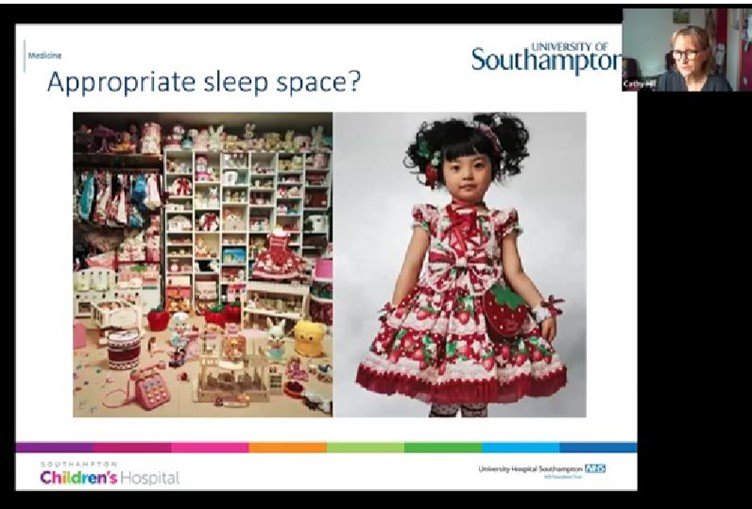
Visual examples: And to make you think, there's a wonderful book about where children sleep around the world, and just look at some of these images. That's an example of a bedroom that's not great for sleep. Stuffed full of toys and entertainment. So, would you go to sleep in there? I think it would be kind of challenging, wouldn't it?
Electronics in the bedroom: And this one, if you have a quick squint around, look at all the electronics. A lot of electronics in the bedroom. We know that electronics have huge benefits for children in terms of learning and lots of children are soothed by electronics, but as I say, we do have this real problem of blue light and accessibility.
If it's there at 3:00 in the morning when you wake up, it's too tempting to want to hop on and have a look.
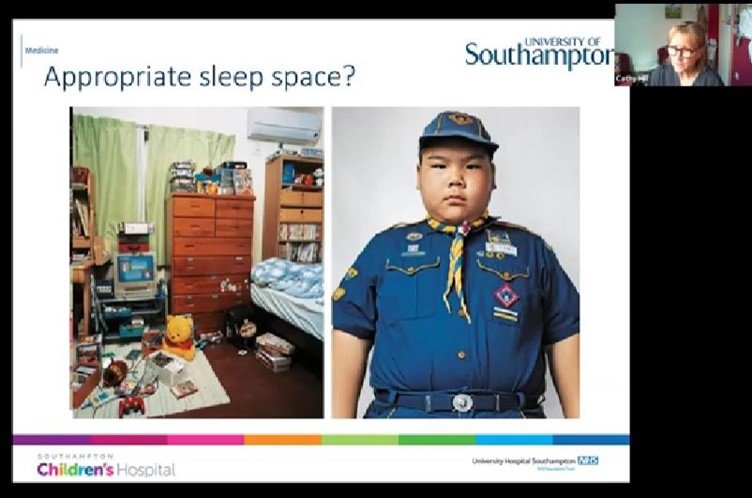
Parental challenges: It's very tempting as parents to think, "Well okay, it soothes the child, whatever gets a night's sleep, let's leave it be." So, I think we have a real challenge in this day and age around accessible tablets and electronics.
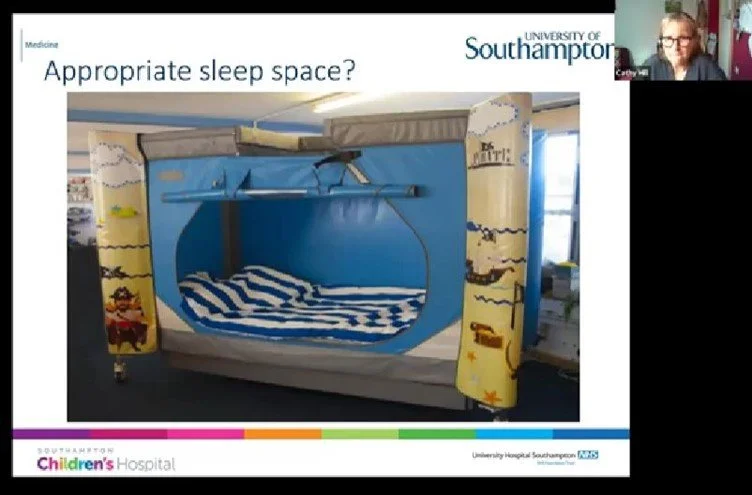
The simple sleep space:And I'm putting that up there because there's an increasing vogue for sleep pods. And actually, as intelligent adults, people pay money to pop into these. This is actually all you need, isn't it? In real life, that's all you need to sleep. A door. Safe comfortable space. So have a little bit of a think about what we're doing sometimes to our children's bedrooms.
Safety sleepers: And for many children, safety sleepers and there's a whole bunch and variety of them out there can be a helpful way of keeping a child safe at bedtime and actually giving a beautiful clear message. This is your lovely safe sleep space. This is where you go to sleep. It's not a play space. So for some children that kind of a sleep space can be very helpful.
Screens and Physical Health Issues
I've talked about screens: I won't labour this, but there's loads of data now showing that more time on screens, even in toddlers and preschoolers, it knocks their nighttime sleep and they take longer to fall asleep. And in school age children, they're more likely to be sleepy in the day and to not have enough sleep at night.
Finding balance: It's not a myth, it's not kind of PC, goodie-two-shoes-people who think ‘keep your children off screens’: it really does make a difference. So we have got to find that delicate balance between all the wonderful, wonderful benefits of screens and keeping the time reasonable. It might be because sometimes children are using the screens instead of going to sleep. It might be that they're too stimulating at bedtime, but we know that light has a big effect.
Underlying medical issues: I think we do have to pay a little bit of attention to things like pain, medical problems like gastroesophageal reflux – if a child's refluxing up their tummy contents and they've got a sore gullet, that's going to make it hard when you lie down flat. Is your child hungry? Has your child had their sensory needs met?
These are all important questions to ask. So here we go.
The sleep jigsaw: It's a bit of a jigsaw puzzle, isn't it, sleep? So to do it well, we've got to be in the right environment, or it helps at the very least. But that's the bedroom environment, but also the child's internal environment. Are they calm? Are they comfortable? Are they free of pain? Are they satiated but not too full of food? You need to be tired, that's self-evident, and your body clock needs to be on the right time zone.
And once all those things are all beautifully lined up, you've actually got to make a positive choice to go to bed because you can make a positive choice not to. We can all decide not to go to bed on any one particular night, even if we're absolutely dead dog tired.
